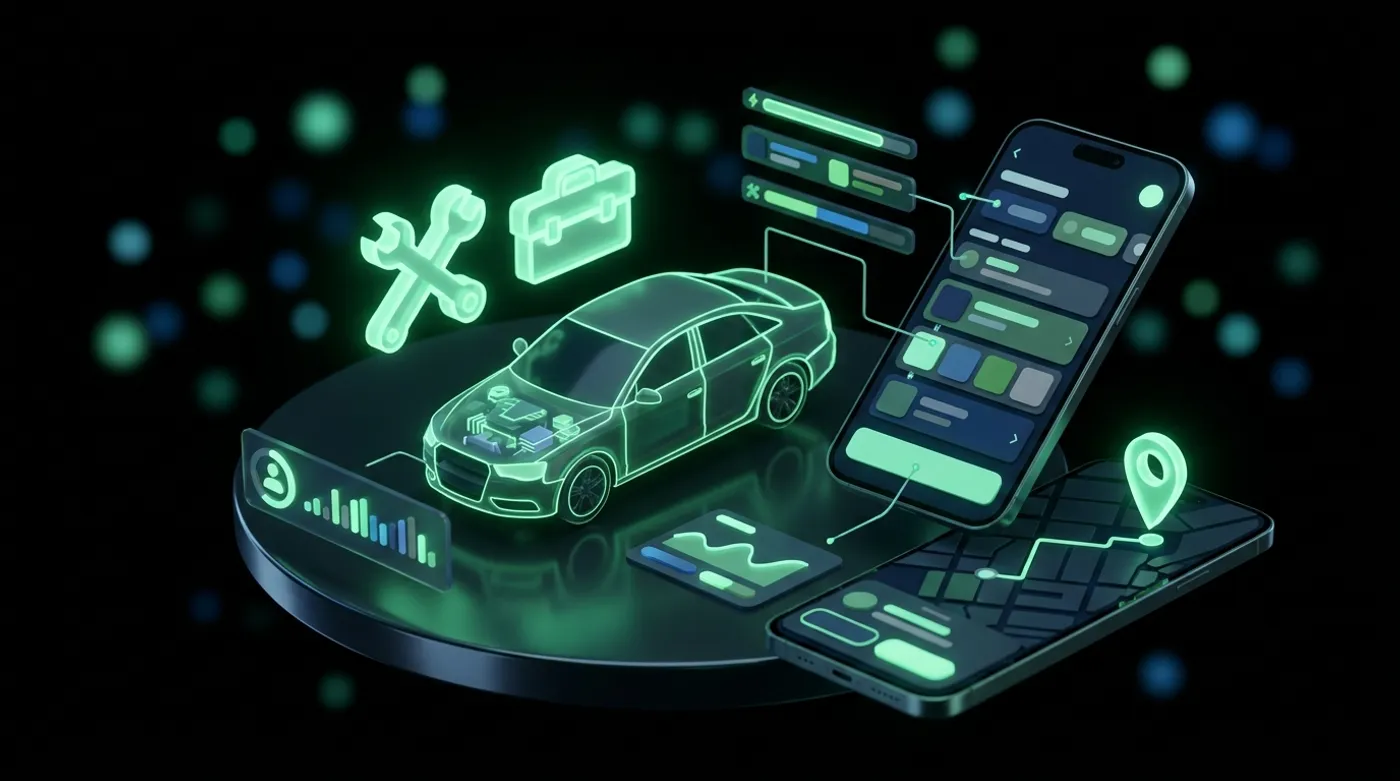
If you’re an auto-service business or a founder eyeing the breakdown-and-service market, car repair app development is the build that turns a fleet of mechanics into a bookable, trackable platform. This guide is for the person building the app, not the driver looking for one: the architecture, the features that matter, the Flutter tech stack, what it costs, and the gotchas that sink first builds.
Car repair runs on the same dispatch model as any home-services marketplace. If you’re scoping a multi-service platform that includes car repair alongside other categories, our home services app covers that pattern with the panels already built.
How an on demand car repair app works
The flow is the same across most platforms:
- Login with phone or email
- Select car model
- Choose the service needed
- Review the service charge estimate
- Confirm booking
- Mechanic arrives at the customer’s location
- Payment confirmed — cash or in-app
The mechanic-dispatch model is functionally the same as any on-demand service marketplace. From a car repair app development standpoint, the differentiation is in catalogue depth (how many service types), geographic coverage, and real-time tracking quality — not the booking flow, which is solved.
A roadside assistance app variant adds one twist: GPS-first booking. The driver is stranded and can’t type an address, so you pin their location automatically and dispatch the nearest mechanic. If roadside is your wedge, build location capture as the first screen, not a settings option.
Core features your car repair app needs
An on demand car repair app without these isn’t production-grade:
- Live tracking — customer sees mechanic en route in real time
- Three-panel structure — car owner app, mechanic app, admin dashboard
- Advanced search filters — service type, scheduling, mechanic ratings
- Multiple payment options — card, wallet, cash on delivery
- Transparent pricing — fare shown before booking confirmation
- Service history — log of all past services with dates and costs
- In-app wallet
- Multilingual support
- Chat/support
- Secure payments
The admin dashboard is worth calling out separately: real-time dispatch visibility, mechanic onboarding management, and earnings reporting are the three things operators actually live in day-to-day. Budget more time here than you think — it’s the panel that decides whether the business runs.
Benchmark the competition before you build
Before scoping your own car repair app, study who already ranks. These five tell you what drivers expect as baseline — match it or beat it, don’t reinvent it.
AUTO I CARE
The largest car breakdown and repair network in India. AUTO I CARE covers 998 cities with 18,000 local car workshops and targets a 20-minute response time in tier-1 and tier-2 cities (30 minutes in tier-3).
Services: breakdown, electrical failure, mechanical failure, accidental support, car parking in tier-1 cities. Covers both domestic and European vehicles. Available via WhatsApp chat or call in addition to the app.
Pitstop
Trusted on-demand car service operating in 9 cities. Pitstop’s main claims: 40% savings versus authorized service stations, 24/7 availability, and 100% genuine spare parts. Pickup and drop service available.
Carfer
For breakdowns, accidents, or monthly services. Carfer operates at the customer’s location and works with certified repair stations. The app surfaces partner shop details and estimated timelines before you confirm.
RepairBuddy
OEM-level information for DIY diagnosis and assisted repairs. RepairBuddy presents detailed diagrams alongside repair procedures — useful for owners who want to understand what’s being done rather than just pay and wait.
GoMechanic
100+ services, 350+ partner service centers in major Indian cities. GoMechanic covers denting and painting, battery replacement, glass repair, and emergency SOS — plus real-time updates and insurance claim support.
Adjacent feature ideas: maintenance tracking
If you want a second revenue stream, the maintenance-tracking layer — service dates, fuel consumption, expense tracking — keeps drivers in your car repair app between breakdowns. These five tracking apps show what the reminder layer can do; bolt a lightweight version onto your platform once the core dispatch flow is stable.
Car Repair — spreadsheet-style tracking for insurance, fuel, service, and parking. Tracks fuel mileage and sends oil change reminders.
CARFAX — maintenance tracking for up to 5 vehicles. Surfaces local repair shop price comparisons and tracks registration due dates.
AUTOsist — covers cars, planes, and boats. Produces PDF-ready reports and provides full service history when selling the vehicle.
Car Problems and Repair — mechanical and electrical fault library with pre-breakdown diagnosis reminders. Works across vehicle types.
Torque — dashboard gauge customization with OBD-II integration. Exports map/track logs to Google Earth KML or CSV format. Useful for owners who want raw engine data.
Car repair app development cost and tech stack
Custom car repair app development typically runs $24,000–$91,000 depending on feature depth, team location, and stack. Flutter is the practical front-end choice — one codebase for iOS and Android, strong performance, and lower ongoing maintenance than two native codebases. On the back end, NestJS (Node) handles dispatch and bookings well; MongoDB stores the service catalogue and job records; Stripe or Razorpay take payments; Firebase Cloud Messaging pushes job alerts to mechanics; and Mapbox or Google Maps powers the live-tracking and nearest-mechanic logic that a roadside assistance app lives or dies on.
How do you decide between building custom, buying a readymade base, or stitching together no-code tools? Here’s the trade-off laid out:
If your business is closer to a home services marketplace that includes car repair alongside other categories, our home services app is worth reviewing — it covers the multi-service on-demand pattern with admin, professional, and customer panels already built, so auto repair app development becomes a configuration job rather than a 0→1 build.
For a custom consultation, contact us directly.
How a car repair app makes money
A car repair platform isn’t a one-revenue-stream business, and that’s the point. Stack these from day one:
- Commission per job. The default. Take 10–20% of each booking. At 1,000 jobs a month averaging $80, a 15% cut is $12,000/month in revenue before you touch anything else.
- Mechanic onboarding and subscription. Charge service providers a monthly fee for premium placement or a verified badge. Predictable recurring revenue that isn’t tied to job volume.
- Spare-parts markup. If you supply genuine parts through the app, a 10–25% markup on batteries, filters, and brake pads adds up fast on high-frequency items.
- Roadside assistance memberships. An annual plan — priority dispatch, capped call-out fees — turns occasional users into recurring subscribers. This is where a roadside assistance app outearns a pure pay-per-job model.
- In-app advertising. Insurance providers and tyre brands pay to reach drivers. Keep it tasteful; intrusive ads tank your ratings.
The honest take: don’t launch with all five. Start with commission, prove supply and demand are balanced in one city, then layer in subscriptions and parts once retention is real.
Build vs buy: our actual recommendation
If you’re a single auto-service business going digital, a readymade base wins on every axis that matters — cost, speed, and you still own the source. Custom car repair app development makes sense once you have a validated model and need behaviour the base can’t express. The mistake we see most is founders spending $50k on a custom build to validate an idea a $5k branded app could have tested in three weeks. Validate cheap, scale custom.
FAQs
What are the core features of a car repair app? Live tracking, three-panel structure (owner, mechanic, admin), advanced search filters, multiple payment options, in-app wallet, chat/support, and service history are the baseline.
What is the best on-demand car repair website? RepairPal, Zonnett, Cartisan, MeriCAR, Alldata, and Pitstop are all established options depending on geography and service type.
Is the on-demand car repair business profitable? Yes. The car industry grows monthly, and on-demand service apps generate revenue from service fees, in-app advertising, and spare parts markups. Multiple revenue streams are available within a single platform.
What does custom development cost? A basic on-demand car repair app runs approximately $24,000–$91,000. A readymade template cuts that significantly if the feature set fits your requirements.
Which tech stack for on-demand car repair? Flutter is the most cost-effective option for cross-platform on-demand apps. Single codebase, strong widget library, and good performance on both iOS and Android. Pair it with NestJS, MongoDB, Stripe or Razorpay, Firebase, and Mapbox for the dispatch and tracking layer.
How long does car repair app development take? A focused MVP on a Flutter base ships in days to a few weeks. A custom three-panel platform built from scratch runs 10–16 weeks depending on how many service types and cities you launch with. The single biggest timeline killer is an over-scoped v1 — cut the service catalogue to your top 10 jobs and add the rest after launch.
Do I need a separate roadside assistance app? No. Roadside is a mode inside the same car repair app — GPS-first booking, priority dispatch, and a membership tier. Build it as a feature flag, not a second product. Treating it as a separate app doubles your maintenance for no benefit.
What’s the hardest part of running the platform? Supply, not software. A clean app with no available mechanics in a customer’s area is worthless. Onboard a dense supply of verified mechanics in one city before you spend a rupee on customer acquisition. Density beats coverage every time at launch.
Found this useful?
We build the apps described in this guide. Readymade or custom — ship in weeks.
Talk to our team →